The fall semester is just about to start, so here are the latest news from the lab!
Frog season
We had unusually high amounts of rain in summer 2025, which meant that it was a good frog season. This year we focused on measuring metabolic rates of calling frogs, combined with measurements of their calling in the field, their resting metabolic rates, and a project by new Ph.D. student Rachel Jacks looking at potential personality traits and how they correlate with metabolism. Meanwhile, Kaleb Banks was busy as usual in year 3 of our crawfish frog project, among other things mapping a whole lot of crayfish burrows.
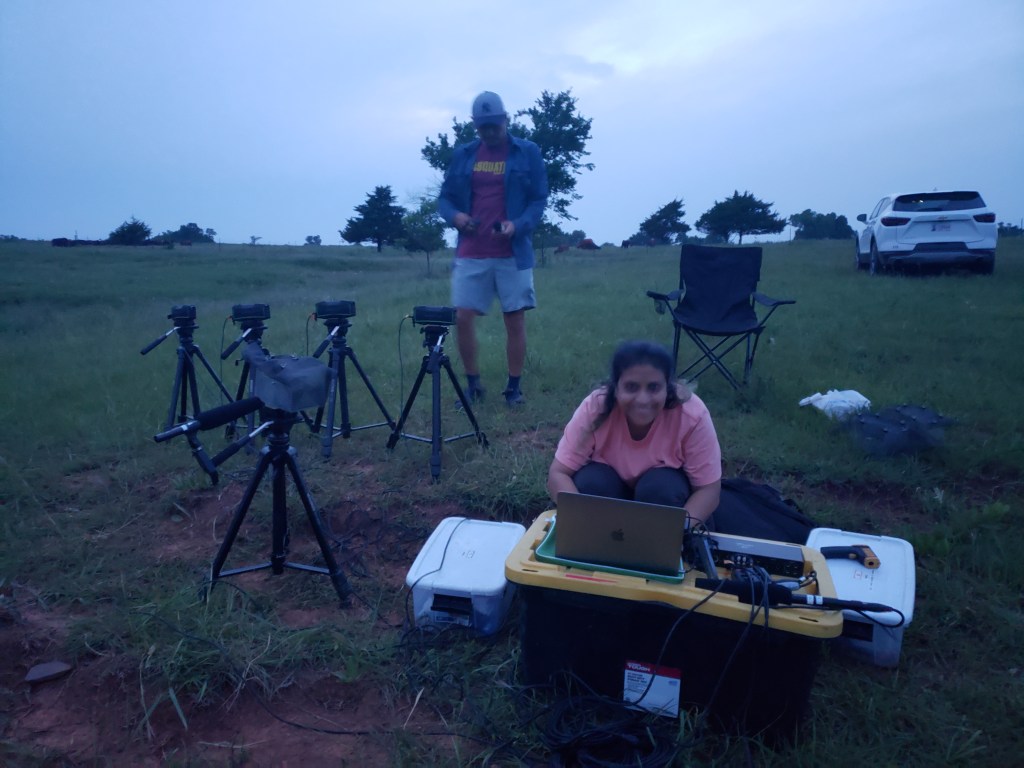
Himidu and Alejandro trying out a complicated 4-speaker playback experiment at Kennedy Pond
Papers
We had papers come out from several collaborations, new and old, including two from Michael’s previous work on great tits in Ireland, one looking at diet variation and another looking at social networks and how they vary across different spatial arrangements of resources. Michael has been working all summer on a follow-up to the social network paper, to be sent out soon. We also had a paper stemming all the way back from Michael’s time in Berlin on competitive signaling in bush-crickets. Another more recent collaboration was published in January, led by Owen Edwards and looking at factors affecting range expansion in green treefrogs. Finally, the first paper from our work on gray treefrog metabolic rates came out in Journal of Experimental Biology. Led by Phoebe Will, we show that there is no relationship between resting metabolic rate and calling.
Conferences
We were well represented at conferences this year:
-Himidu Pitigala and Kayleen Sugianto presented at Evolution. Kayleen took part in the UDE program at the conference!
-Kaleb Banks presented at ASIH
-Alejandro Marcillo, Michael Reichert and Rachel Jacks presented at the Animal Behavior Society conference
-Kennedy Funa and Kayleen Sugianto both presented at the National Conference on Undergraduate Research
-On campus, Brendan Dehner presented at the ON-RaMP symposium, Kennedy Funa presented in the Wentz Symposium, McKenna Shearer presented at the Freshman Research Scholars Symposium, and Kennedy, Sara Keyser and Raygan Kyeremateng presented at the OSU Undergraduate Research Symposium.
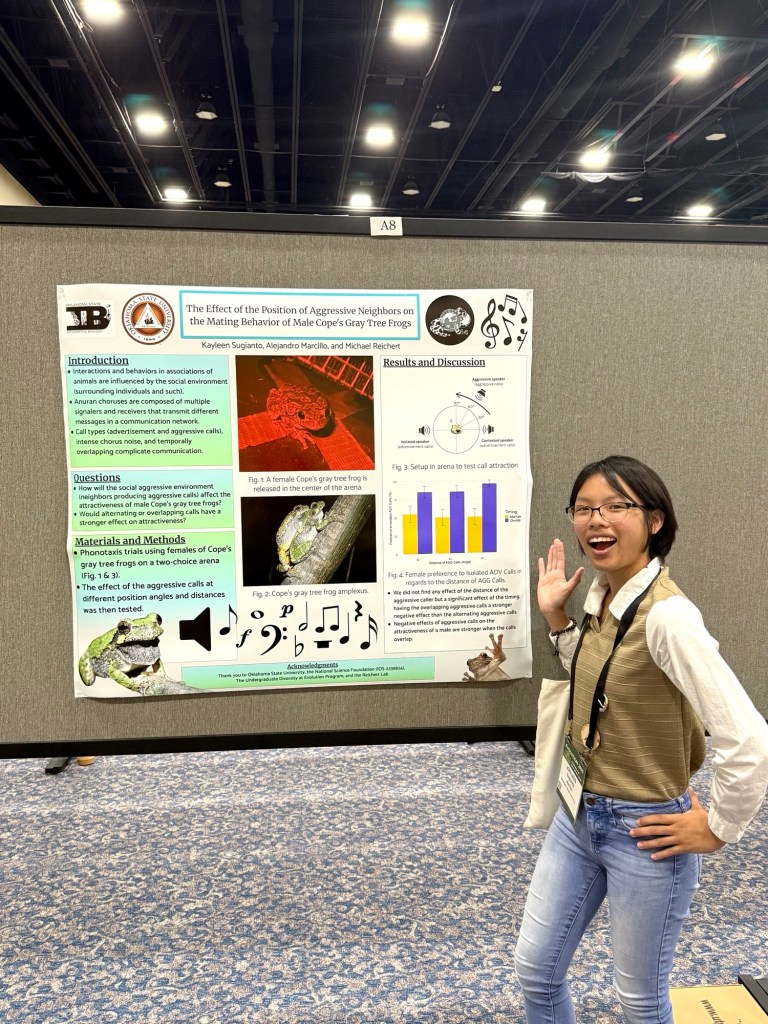
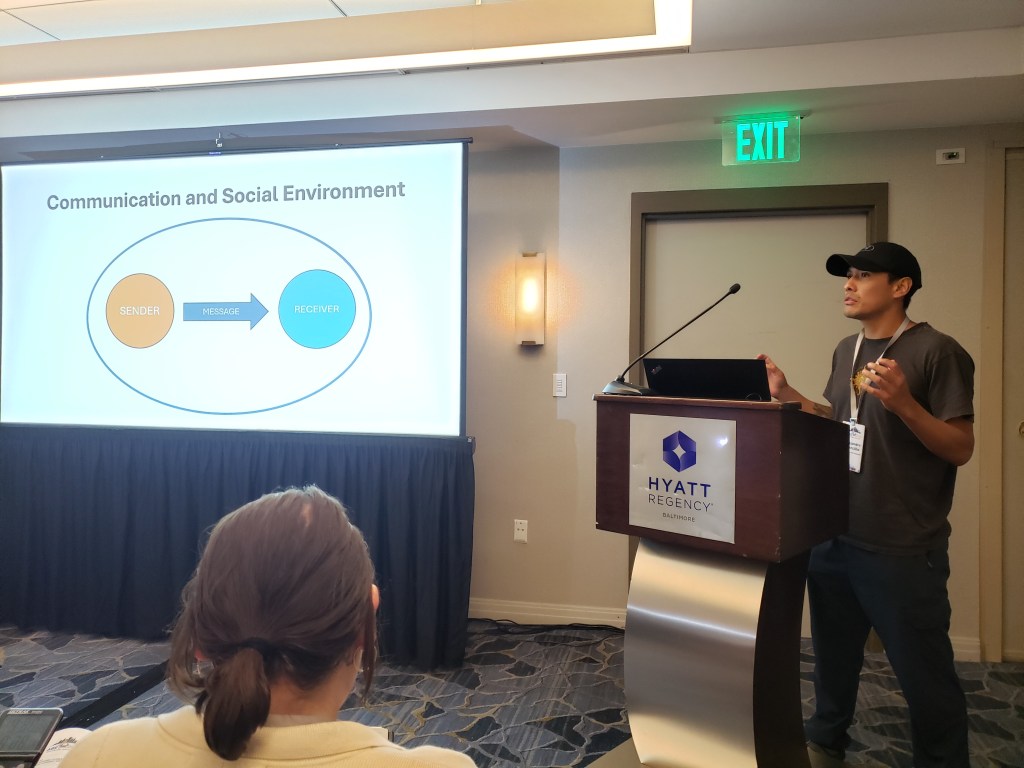
Above, Kayleen Sugianto presented at Evolution and Alejandro Marcillo’s talk from ABS
Other news, good and bad
As part of our NSF CAREER grant, and in collaboration with Galactic Polymath, we developed a set of lessons for high school science students on trade-offs in biology. The first lessons have already been used in several classrooms! These lessons include videos (featuring Michael, Phoebe and Kayleen from the lab), real data from our previous work, and fun exercises to get students working with real scientific data: https://teach.galacticpolymath.com/units/en-US/14
Another fun outcome of the Galactic Polymath collaboration was building an online sound analysis software called Soundlab. We think this will be an excellent tool for teaching and learning about the properties of sound.
Unfortunately our NSF funded ON-RaMP program was one of hundreds of NSF grants that were terminated by the government. This was a very detrimental action that caused us to have to cancel the final year of the program, resulting in us turning down 10 mentees that we had previously made offers to. In addition to a staff position that was cut, this cost 11 jobs, and included some loss of personal funds for participants who had arranged plans to come to campus, as well as waste of state taxpayer funds as the university devoted time and energy to shutting down a program unexpectedly. Most importantly, a very successful program for training students to do science, along with the actual research projects they would do, was cut short, limiting the development of the US scientific workforce. For our lab, Brendan Dehner was in the program when it was cut but thankfully had completed most of his work and was able to finish without major disruptions. However, we had made an offer to Natalie Mitchell, a promising student, which had to be rescinded. Thankfully, we were able to come up with an alternative position for Natalie, who will be joining a lab as a MS student in the fall.
To highlight the serious damage to American science caused by these actions, Michael presented a poster about ON-RaMP in Washington D.C. and spoke with press and congressional workers about our successes and what we lost.
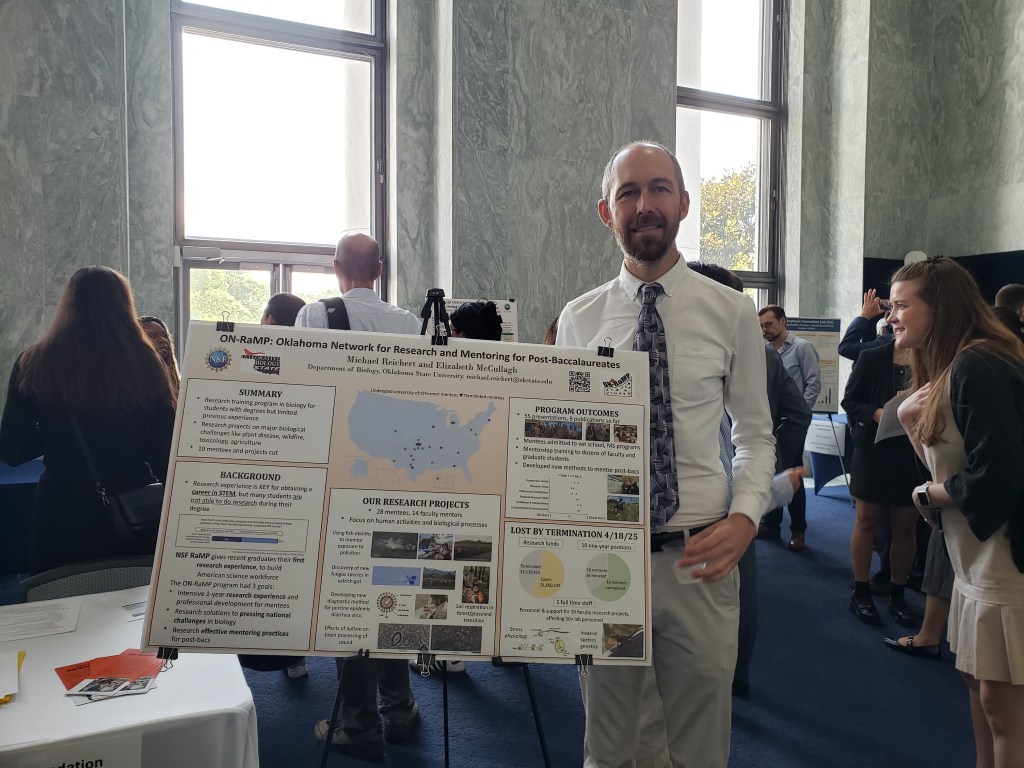
Michael presenting a poster about the canceled ON-RaMP program to press and political aides in Washington D.C.
 l
l Reichert Lab